

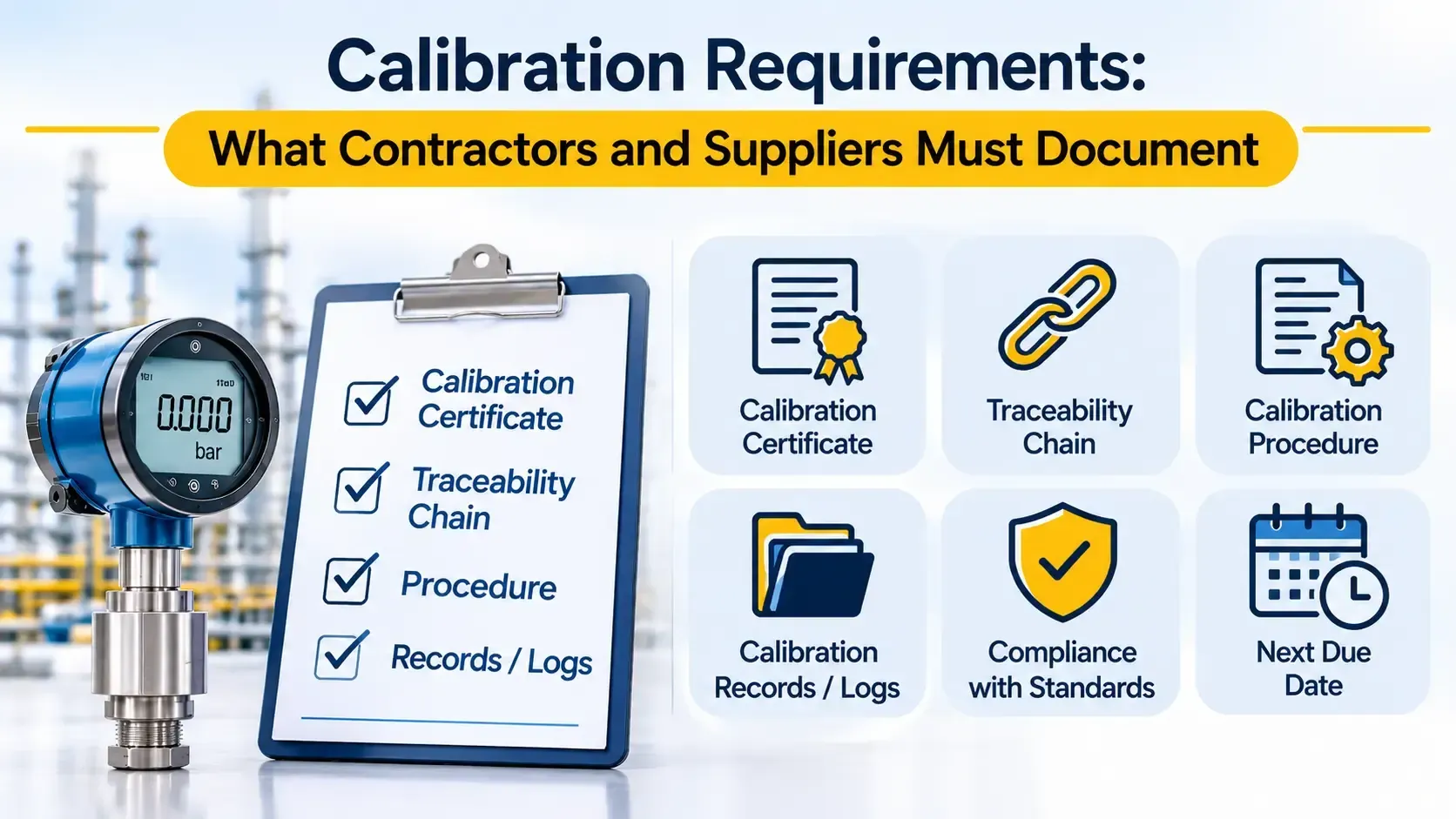
A rejected calibration certificate can stop a delivery, hold up an inspection or delay a project sign-off. Most of these rejections come from missing or inconsistent paperwork, not from bad instruments.
If you work with Saudi Aramco in the Eastern Province, in Dammam, Jubail or Dhahran, you will be asked to prove that every measuring instrument is accurate and traceable. This guide explains the Aramco calibration requirements that contractors and suppliers meet most often, and what to put in your documentation file so it survives an audit.
One note first. Aramco requirements can differ by contract, project and inspection plan. Always confirm the exact clauses in your purchase order, scope of work and quality plan.
What Aramco Calibration Requirements Mean for Contractors and Suppliers
Aramco does not treat calibration as a formality. Instruments on pressure systems, flow lines, safety devices and torque-critical joints directly affect safety and product quality. That is why the Saudi Aramco Inspection Department and project quality teams look closely at how you control measurement.
In practice, the requirements come down to three questions:
- Is every instrument that affects quality or safety identified and under control?
- Was it calibrated by a competent, traceable source within its valid interval?
- Can you prove it with records that match the instrument physically on site?
If you can answer yes to all three, with documents to back it up, most Aramco contractor calibration requirements are covered.
Aramco Contractor Calibration Requirements: The Documents You Need Ready
Here is the core calibration documentation for Aramco suppliers and contractors. Keep it organised per project and available on request.
Master equipment list
A register of every measuring and test instrument used on the job. Each entry should carry a unique ID, description, make, model, serial number, range, location, last calibration date and next due date.
Valid calibration certificates
One certificate for each instrument, issued by a competent laboratory, with the serial number matching the instrument in the field.
Calibration procedures and records
The method used, the reference standards, and the as-found and as-left data. Your own internal checks belong here too.
Traceability evidence
The link from the instrument back to national or international standards. Your lab's accreditation scope supports this.
Calibration labels or stickers
Each instrument shows its ID, calibration date and due date. Auditors check the label first and the file second.
Out-of-tolerance records
What you did when an instrument was found outside tolerance, including which earlier measurements were reviewed.
Aramco Calibration Certificate Requirements: What Every Certificate Must Show
A certificate is only useful if an inspector can read it and trust it. Under ISO/IEC 17025, a good certificate includes:
- Laboratory name, address and accreditation body reference
- A unique certificate number and the date of calibration
- A clear description of the instrument, including serial number and ID
- The calibration method or procedure used
- Reference standards used, with their own traceability
- As-found and as-left results where adjustment took place
- Measurement uncertainty stated for the results
- Environmental conditions where they affect the result
- Authorised signature and issue date
Many suppliers lose time because they cannot interpret what they receive. Our guide on how to read a calibration certificate explains as-found, as-left and uncertainty in plain terms.
ISO 17025 Calibration for Aramco: Why Accreditation Is the Baseline
ISO/IEC 17025:2017 is the international standard for calibration laboratory competence. For most Aramco work, a calibration certificate from an accredited lab is the safest way to show your results are credible.
Accreditation matters because it is independent. In Saudi Arabia, the Saudi Accreditation Center (SAC) assesses labs against the standard. Labs under bodies recognised through the ILAC Mutual Recognition Arrangement (ILAC MRA) give buyers confidence that results are accepted internationally.
Check three things before you accept any accredited certificate:
- The accreditation body is recognised, and the certificate carries its mark or reference.
- The accreditation is current, not expired or suspended.
- The scope covers your instrument type, range and uncertainty, because accreditation applies only to what is listed in the scope.
That third point causes most disputes. A lab can be accredited and still not be accredited for your specific instrument. For a deeper look, read what ISO 17025 accreditation means for Saudi buyers.
Saudi Aramco Approved Calibration Lab: What the Label Really Means
Suppliers often search for a "Saudi Aramco approved calibration lab" and assume a single approved list exists. In reality, acceptance usually depends on the contract, the project quality plan and the Aramco inspection or quality team reviewing the work.
What reviewers consistently look for is accreditation to ISO/IEC 17025, a relevant scope, traceable references and complete certificates. Treat accreditation as the baseline, then confirm lab acceptance with the Aramco representative or inspector on your project before you commit.
Calibration Traceability for Aramco: The Chain Inspectors Follow
Traceability means an unbroken chain of comparisons from your instrument up to national or international measurement standards. Each step in the chain has a stated uncertainty.
A typical chain looks like this:
- Your field instrument is calibrated against the lab's working standard.
- The working standard is calibrated against a higher-level reference standard.
- The reference standard is traceable to a national metrology institute, such as NIST, or an equivalent recognised body.
Aramco inspectors ask for this because a certificate without traceability only proves that someone compared two numbers. It does not prove the numbers were right. This is why every credible certificate names its reference standards and their own calibration status.
Calibration Documentation for Aramco Suppliers: Building a File That Survives an Audit
Good documentation is built through habit, not last-minute effort. These practices make audits routine.
Set calibration intervals with a reason
Many suppliers default to 12 months. That is common, but it is not a rule. High-use, safety-critical or harsh-environment instruments often need shorter intervals. Record why you chose each interval and review it when as-found data shows drift.
Use as-found data to protect past work
If an instrument is found out of tolerance, the as-found reading tells you how long it was wrong. That lets you judge which earlier measurements are affected. Without it, you may have to repeat work.
Match every certificate to the physical instrument
Serial numbers, IDs and tags must agree across the equipment list, the certificate and the instrument itself. A single mismatch can invalidate a certificate in the inspector's eyes.
Plan calibration around project milestones
Calibration due dates should never fall in the middle of a test or inspection. Build a calendar that shows due dates 30 to 60 days ahead.
For lab and site options, see our comparison of onsite versus lab calibration.
Why Aramco Calibration Documents Get Rejected
The same problems appear again and again. Avoid these and you avoid most delays.
- Expired certificates: the due date passed before the instrument was used on the job.
- Scope mismatch: the lab is accredited, but not for that instrument, range or uncertainty.
- Serial number errors: the certificate does not match the instrument in the field.
- Missing uncertainty or traceability statements.
- Unaccredited sources: certificates from a vendor that cannot show an accreditation scope.
- No as-found data: the instrument was adjusted before its original condition was recorded.
- Missing or damaged labels on the instrument.
- Late calibration: instruments sent for calibration after the work had started.
If a certificate is rejected, the usual consequence is that work using that instrument must stop until a valid certificate is provided. In some cases, previous measurements must be reviewed or repeated.
Aramco Vendor Calibration Compliance: A Practical Checklist
Use this before every audit, inspection or delivery.
- Every instrument that affects quality or safety is on the master equipment list.
- Each has a certificate from an ISO/IEC 17025 accredited lab, within its due date.
- The lab's scope covers the instrument type, range and uncertainty.
- Serial numbers match across the list, the certificate and the instrument.
- Traceability to national or international standards is stated.
- As-found and as-left data are recorded.
- Labels show ID, calibration date and due date.
- Out-of-tolerance events have a documented review.
- The calendar shows upcoming due dates well ahead of project milestones.
How to Choose a Calibration Lab for Aramco Work in Saudi Arabia
Choose on competence and coverage, not price alone.
- Accreditation: ask for the current scope, not just the certificate.
- Discipline coverage: a lab that handles dimensional, electrical, pressure and temperature work saves you from managing several vendors.
- Onsite capability: avoid removing instruments from active lines when possible.
- Turnaround: confirm realistic timelines before shutdowns and inspections.
- Documentation quality: ask for a sample certificate before you commit.
Our checklist on how to choose a calibration lab in Saudi Arabia walks through ten points in detail. For pressure instruments specifically, see our guide to the pressure gauge calibration procedure.
General Tech Saudi has operated from Al Rabie, Dammam since 1998. Our ISO 17025 calibration services in Saudi Arabia cover eleven disciplines, in the lab or on site, with as-found and as-left readings and traceability stated on every certificate. Industrial buyers who need compliant instruments as well can explore our instrument sales range.
Frequently Asked Questions
What calibration documents do Aramco contractors need to submit?
Contractors typically need a master equipment list, valid calibration certificates for each instrument, traceability evidence and calibration labels on the instruments. As-found and as-left records are also expected. The exact submission list depends on your contract and project quality plan, so confirm it with your Aramco representative.
Does Aramco require ISO/IEC 17025 accredited calibration?
For most quality-critical and safety-related work, accredited calibration is the accepted baseline, because it proves independent assessment of the lab's competence. Requirements vary by contract, so check your scope of work. Even where it is not mandated, accredited certificates are far less likely to be challenged.
How often should instruments be calibrated for Aramco projects?
There is no single universal interval. Twelve months is a common starting point, but safety-critical or heavily used instruments often need shorter cycles. Follow the interval in your contract or quality plan, and adjust it using as-found drift data.
What happens if a supplier's calibration certificate is rejected?
Work using the affected instrument usually pauses until a valid certificate is issued. Inspectors may also ask you to review or repeat earlier measurements. Fixing the cause quickly, usually by recalibrating with an accredited lab, limits the delay.
Can I get calibration on site instead of sending instruments to a lab?
Yes, for many instrument types. Onsite calibration reduces downtime and removes transport risk, provided the provider brings traceable references and issues the same quality of certificate as in the lab.
Get Your Instruments Audit-Ready
Strong documentation protects your project schedule and your reputation. If you need accredited, traceable calibration in Dammam, Jubail, Dhahran or anywhere across the Kingdom, General Tech Saudi can help.
Request a quote, call +966 569 289 544, or email sales@generaltechsaudi.com.