

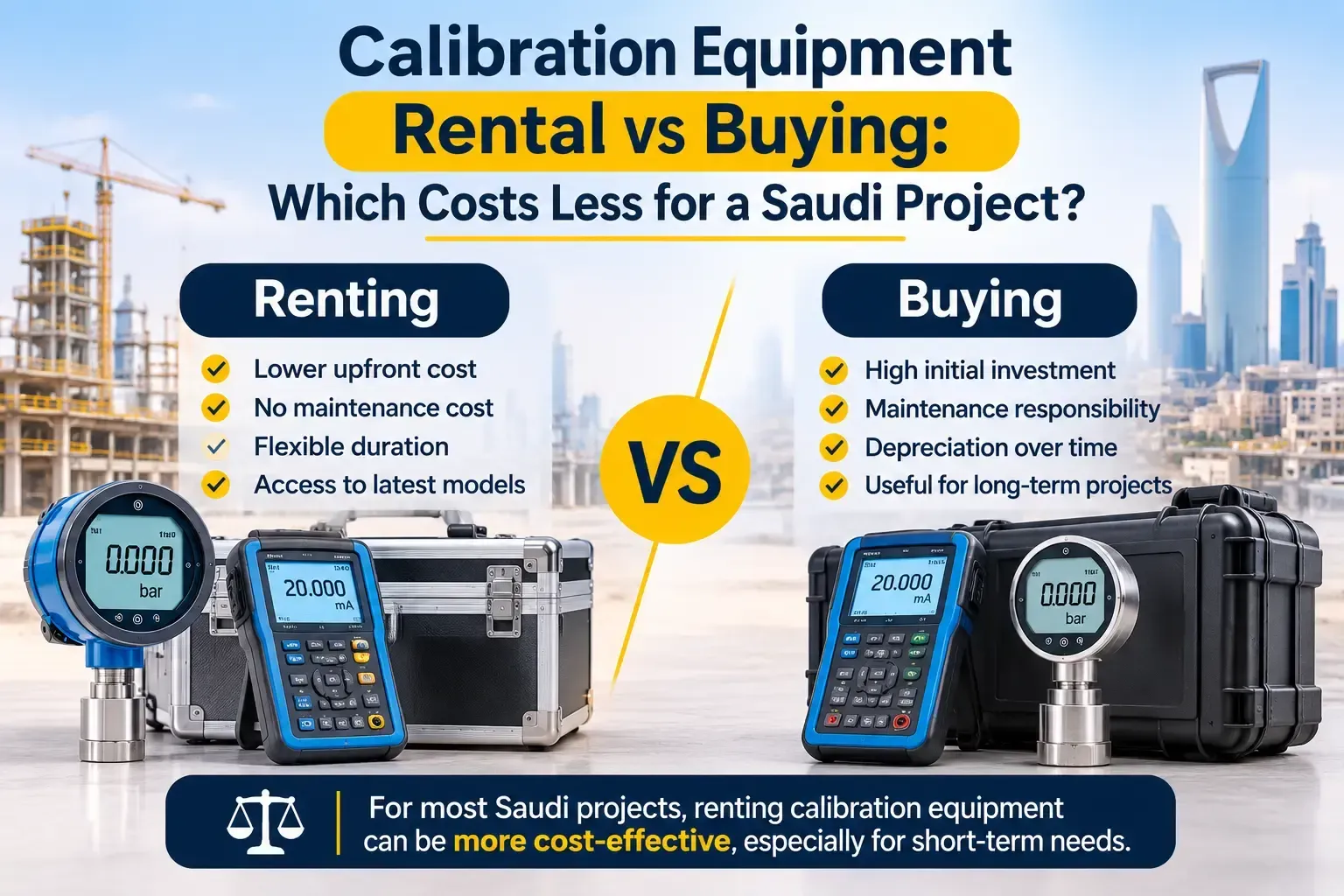
Every project manager hits the same question sooner or later: do we rent the test and calibration equipment, or buy it? The wrong answer can burn budget or stall your schedule.
The honest answer is that calibration equipment rental wins on some projects and buying wins on others. The deciding factors are how long you need the equipment, how often you will reuse it and how much calibration and downtime will cost along the way.
This guide gives you a simple way to compare both options for a Saudi project, with a break-even example you can adapt to your own numbers.
Calibration Equipment Rental vs Buying: The Short Answer
As a rule of thumb:
- Rent when the need is short, one-off or uncertain, or when the equipment is expensive and rarely used.
- Buy when you will use the equipment across many projects, need it on call, or can spread its cost over several years.
Between these two sits a grey zone, usually projects of 6 to 12 months. That is where a proper cost comparison pays off.
What Counts as Calibration Equipment?
The term covers two different things, so be clear which you mean:
- Calibrators and reference standards: dead weight testers, pressure and temperature calibrators, multifunction process calibrators and torque testers. These are used to calibrate other instruments.
- Test and measuring instruments: multimeters, pressure gauges, torque wrenches, thermometers and loggers. These take readings on site and need their own calibration.
Rental is common for both. The rules that matter are the same, though: whatever you use must carry a valid, traceable calibration certificate.
The True Cost of Buying
The purchase price is only the start. Count these costs over the period you will own the equipment:
- Purchase price, including import, freight and customs clearance where relevant
- Recurring calibration, usually every 12 months, sometimes sooner for heavy use
- Repair and maintenance, including spare parts and service
- Storage and handling, including protection from heat, dust and transport damage
- Idle time, because equipment sitting on a shelf still costs you money
- Depreciation or resale value, which cuts the net cost if you can sell later
VAT applies to both purchases and rental. Include it in the comparison so you compare like with like.
For a detailed view of the calibration line item, see our guide on calibration cost in Saudi Arabia, which explains the eight factors that set the price.
The True Cost of Renting
Rental looks simple, but a few items change the total:
- Daily, weekly or monthly rates: longer terms usually lower the monthly rate
- Delivery and collection, especially for remote sites
- Deposits or damage liability
- Late-return charges if your project overruns
- Calibration status: the equipment must arrive with a current certificate
That last point is critical. A rental unit with an expired or unclear certificate is a liability, not a saving.
Break-Even Example: Rent vs Buy
The numbers below are illustrative only, not quotes. Replace them with real prices for your equipment.
Assume you need a pressure calibrator for a project:
- Purchase price: SAR 40,000
- Annual calibration: SAR 1,500
- Expected resale value after one year: SAR 16,000
- Rental rate: SAR 3,000 per month
Net cost of buying over 12 months: 40,000 + 1,500 − 16,000 = SAR 25,500
- 4 months: rental SAR 12,000 vs buying SAR 25,500. Rent is cheaper.
- 6 months: rental SAR 18,000 vs buying SAR 25,500. Rent is cheaper.
- 9 months: rental SAR 27,000 vs buying SAR 25,500. Buying is marginally cheaper.
- 12 months: rental SAR 36,000 vs buying SAR 25,500. Buying is cheaper.
The break-even sits near 8.5 months (25,500 ÷ 3,000). Beyond that, buying is cheaper, and the gap widens if you reuse the equipment on a second project.
The simple formula is: break-even months = (purchase price + calibration − resale value) ÷ monthly rental rate.
Run this for each instrument, not for the project as a whole. A cheap multimeter and an expensive reference standard rarely belong in the same decision.
When Renting Makes More Sense
Renting is usually the better call when:
- The project is short, such as a plant shutdown, a commissioning phase or an audit preparation.
- The equipment is specialised and rarely used, where purchase cost would sit idle for years.
- You need a backup fast, because your own instrument failed or a supplier delivery slipped.
- You want to evaluate before buying, to confirm a model suits your work.
- Cash flow is tight, and spreading cost over the project protects working capital.
- Technology changes quickly, so owning risks obsolescence.
When Buying Makes More Sense
Buying is usually the better call when:
- You use the equipment regularly across several projects each year.
- You need it on demand, without waiting for availability or delivery.
- The project will run beyond the break-even point.
- Your quality system needs full control over calibration history, handling and records.
- You can resell, especially for well-known brands that hold value.
- You hold the equipment to a strict interval, and want to manage it yourself.
Calibration and Certificates: The Hidden Deciding Factor
Whichever option you choose, calibration status decides whether the equipment is usable on your project.
If you rent, ask for:
- A current calibration certificate from an ISO/IEC 17025 accredited lab
- A traceability statement and stated measurement uncertainty
- A calibration due date that covers your whole rental period
- Confirmation that the accreditation scope covers the instrument and range
If you buy, plan for:
- An annual calibration schedule, tracked on your master equipment list
- As-found and as-left records for every cycle
- A lab that can calibrate your equipment type, in the lab or on site
Our guide on how to read a calibration certificate shows what to check before accepting any certificate. If your work is for oil and gas clients, note that Aramco calibration requirements expect valid, traceable records for every instrument that affects quality or safety, whether owned or rented.
Calibration Intervals: Rent or Buy?
Calibration intervals affect the maths. A torque tool used heavily may need calibration well before 12 months, which adds cost if you own it.
For example, our torque wrench calibration interval guide explains how time and usage cycles set the schedule. If an instrument will reach its interval during your project, factor that cost into the buy side, or choose rental with a fresh certificate.
Onsite or Lab Calibration for Owned Equipment
If you buy, you will also need to decide how to calibrate. Sending instruments to the lab removes them from service. Onsite calibration keeps them working but costs more per visit.
Our comparison of onsite versus lab calibration explains which suits Saudi facilities and when. For large fleets or remote sites, onsite visits often cut downtime enough to justify the extra cost.
A Practical Decision Checklist
Answer these five questions for each instrument:
- How many months will we need it? Compare against your break-even point.
- Will we reuse it within the next two years? If yes, lean towards buying.
- Can we tolerate waiting for availability? If not, buy or reserve early.
- Does it arrive with a valid, traceable certificate that covers the whole period? If not, do not rent it.
- Do we have a plan and budget for ongoing calibration? If not, solve this before buying.
If most answers point one way, you have your decision.
How General Tech Saudi Can Help
Whether you buy or hire, a trusted calibration partner keeps your records clean. General Tech Saudi supplies industrial measuring instruments and test equipment as an authorised distributor, and provides ISO 17025 calibration services in Saudi Arabia from our Dammam lab, in the lab or on site.
Share your project length and instrument list, and we will help you compare the options.
Frequently Asked Questions
Is it cheaper to rent or buy calibration equipment?
It depends on how long you need it. Renting is usually cheaper for short projects, often under 6 to 9 months. Buying becomes cheaper once usage passes the break-even point, or when you will reuse the equipment across several projects. Run the break-even formula for each instrument.
How do I calculate the break-even point?
Add the purchase price and calibration costs, subtract expected resale value, then divide by the monthly rental rate. The result is the number of months after which buying costs less. Include delivery, deposits and VAT on both sides for a fair comparison.
Does rented calibration equipment come with a certificate?
It should. Always ask for a current ISO/IEC 17025 accredited calibration certificate with traceability and uncertainty stated. Check that the due date covers your entire rental period, and that the lab's scope covers the instrument and range.
How often must I calibrate equipment I buy?
Many users follow a 12-month interval, but there is no universal rule. Heavy use, harsh environments and safety-critical work often need shorter intervals. Follow your quality plan or contract, and adjust using as-found data from each calibration.
Can I rent equipment and still meet Aramco or client audit requirements?
Yes, as long as the equipment has valid, traceable calibration records that match its serial number and cover the period of use. Requirements vary by contract, so confirm what your client or inspector expects before you commit.
Get a Clear Answer for Your Project
Send us your equipment list and project timeline, and we will help you compare the options with real numbers. Request a quote, call +966 569 289 544, or email sales@generaltechsaudi.com.