

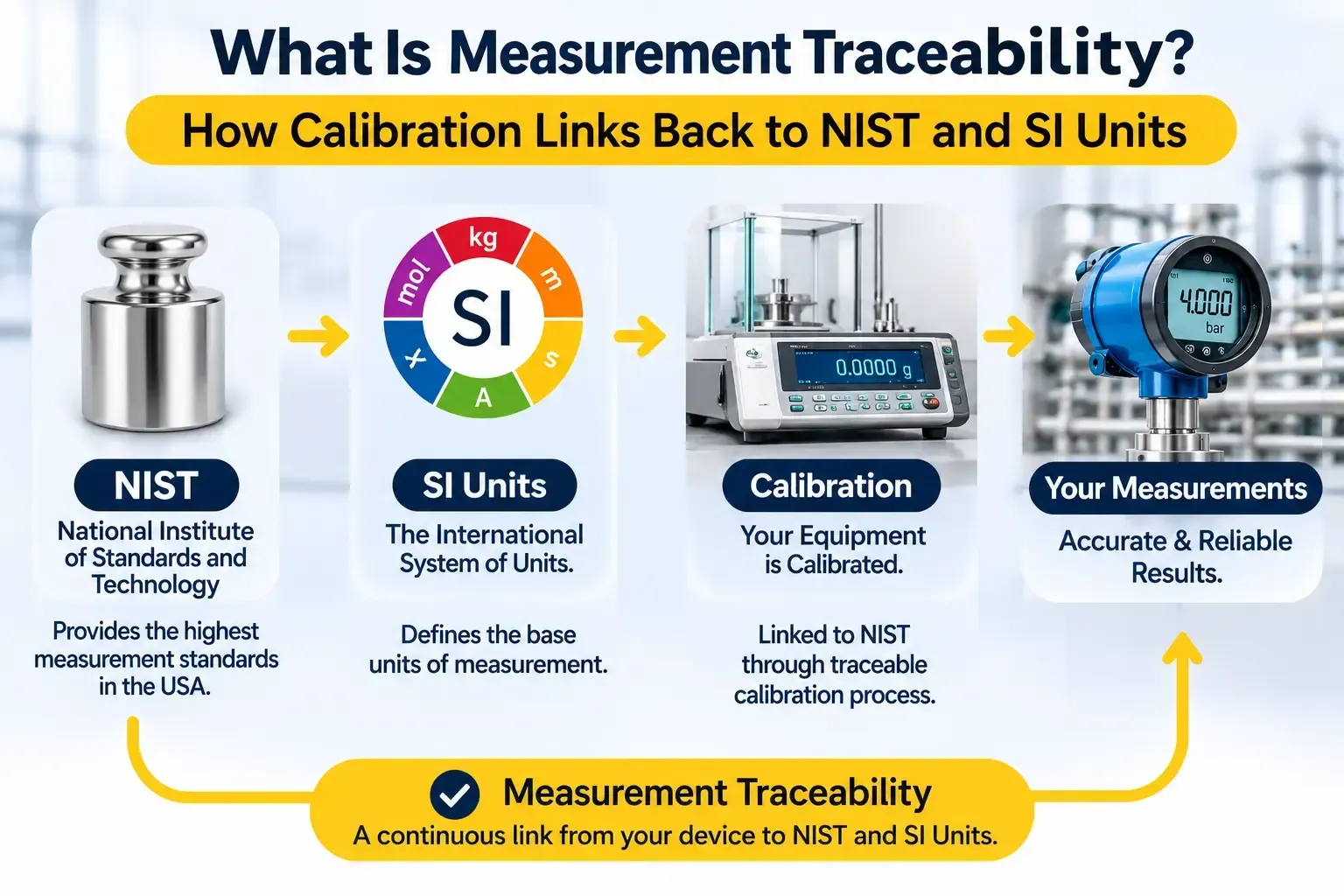
Every calibration certificate makes a quiet promise: this reading can be trusted. Measurement traceability is the reason that promise holds. Without it, a certificate only shows that two instruments were compared, not that either one was right.
This guide explains what measurement traceability means, how the chain runs from your instrument to the SI units, and what "NIST traceable" really covers. It also shows what to check on a certificate so your records stand up to an audit in Saudi Arabia.
What Is Measurement Traceability?
Measurement traceability, formally called metrological traceability, is the property of a result that lets you relate it to a reference through a documented, unbroken chain of calibrations. Each link in that chain adds its own measurement uncertainty.
In plain terms, your instrument is checked against a better one. That one is checked against a better one still. The chain continues until it reaches a national or international standard.
Three things must be present for traceability to be real:
- An unbroken chain: no step is skipped or undocumented.
- Stated uncertainty at every step: each comparison says how good it is.
- Competent calibration at every step: each lab can show it is qualified to do the work.
If any one is missing, the chain is broken, and so is the claim.
How Calibration Links Back to SI Units
At the top of every traceability chain sits the International System of Units (SI). The SI defines the seven base units: second, metre, kilogram, ampere, kelvin, mole and candela. Since 2019, all seven are defined through fixed values of natural constants rather than physical objects.
That matters in practice. A kilogram no longer depends on one artefact in a vault. Any national metrology institute with the right equipment can realise the unit, and results can be compared worldwide.
Every other quantity you measure on site, such as pressure, torque, force, voltage or temperature, is derived from these base units. Calibration is how that definition reaches the gauge on your pipeline.
The Traceability Chain, Step by Step
A typical chain looks like this:
- SI unit definition: the unit is defined by international agreement.
- National metrology institute (NMI): realises the unit with primary standards. Examples include NIST in the United States, PTB in Germany and NPL in the UK. In Saudi Arabia, this role sits with the national metrology body under SASO.
- Accredited calibration laboratory: its reference standards are calibrated by, or traceable to, an NMI.
- Working standards: calibrated against the lab's reference standards for daily use.
- Your instrument: calibrated against the working standards, with a certificate that records the result.
Notice that uncertainty grows slightly at each step down. That is expected. What matters is that every step states it.
A practical example: pressure gauge
Take a pressure gauge on a process line. The lab checks it against a dead weight tester. The tester's masses are calibrated against reference masses. Those masses trace back to the national mass standard, and ultimately to the kilogram.
Our pressure gauge calibration procedure guide shows how this works at the bench, including hysteresis and gravity correction.
What Does "NIST Traceable" Really Mean?
"NIST traceable" is one of the most used and least understood phrases in calibration.
NIST does not certify labs or issue a "NIST traceable" stamp. The phrase means a lab's reference standards are linked to NIST through an unbroken chain of calibrations with stated uncertainties.
That link can be direct, through NIST calibration, or indirect, through another NMI that has international recognition. Under the CIPM Mutual Recognition Arrangement, NMIs accept each other's measurement capabilities. This is why a Saudi lab's results can be traceable to NIST or to an equivalent institute without every instrument travelling to America.
So when you read "NIST traceable" on a certificate, ask a follow-up question: through which chain, and with what uncertainty?
Why Traceability Needs Accreditation
Anyone can write "traceable" on a document. Accreditation is what makes the word credible.
ISO/IEC 17025:2017 requires calibration laboratories to ensure metrological traceability of their results. Accreditation bodies then assess whether the lab can actually prove it. In Saudi Arabia, that body is the Saudi Accreditation Center (SAAC). Labs accredited by bodies in the ILAC Mutual Recognition Arrangement give results accepted across borders.
One point catches many buyers out. Accreditation applies to a scope, meaning specific instruments, ranges and uncertainties. A lab can be accredited and still not be accredited for your instrument. Our guide on what ISO 17025 accreditation means for Saudi buyers explains how to check this.
How to Check Traceability on a Calibration Certificate
You do not need to be a metrologist to verify a certificate. Look for these items:
- A traceability statement naming the national or international standards the results link to
- The reference standards used, with IDs and their own calibration dates
- Measurement uncertainty stated for the results
- The accreditation body mark and certificate or scope reference
- The calibration date and a unique certificate number
- As-found and as-left data, where adjustment took place
Our article on how to read a calibration certificate walks through each field with examples.
If a certificate has no traceability statement, no uncertainty or no named reference standards, treat it with caution. It may not be accepted by an auditor.
Traceability, Uncertainty and Test Accuracy Ratio
Traceability and uncertainty always travel together. A traceable result with a huge uncertainty may still be useless for your tolerance.
A common rule of thumb is a 4:1 test accuracy ratio. The reference should be about four times more accurate than the instrument under test. Where that is not achievable, the lab should state uncertainty clearly so you can judge pass or fail with confidence.
This is why a torque wrench, for example, needs a reference of suitable class and a documented chain. Our guide to torque wrench calibration intervals covers how intervals and traceable certificates fit together.
Common Traceability Mistakes
These errors appear again and again in audits:
- Accepting "traceable" with no evidence: a statement alone is not proof.
- Ignoring the lab's scope: the lab is accredited, but not for your instrument or range.
- Using expired reference standards: the chain breaks if a standard is out of date.
- Skipping uncertainty: results cannot be judged without it.
- Mixing up calibration and verification: a quick check against an uncalibrated reference does not create traceability.
Traceability also drives compliance in regulated sectors. For example, Aramco calibration requirements ask contractors to show traceable, documented records for every instrument that affects quality or safety.
How to Choose a Lab That Can Prove Traceability
Choose a lab that makes its chain easy to verify:
- Ask for the current accreditation scope, not just the certificate.
- Confirm the scope covers your instrument type, range and uncertainty.
- Request a sample certificate and check the traceability statement.
- Ask which reference standards will be used and when they were last calibrated.
- Confirm onsite or in-lab options based on your downtime limits.
Our 10-point checklist for choosing a calibration lab in Saudi Arabia covers each point in more depth.
General Tech Saudi provides ISO 17025 calibration services in Saudi Arabia from our Dammam lab, with traceability stated on every certificate.
Frequently Asked Questions
What is measurement traceability in simple terms?
Measurement traceability means you can follow a measurement result back to a recognised standard through a documented, unbroken chain of calibrations. Each step states its uncertainty. It is what lets you trust that a reading in Dammam matches the same reading anywhere else in the world.
What does NIST traceable mean?
NIST traceable means a lab's reference standards are linked to NIST through an unbroken chain of documented calibrations with stated uncertainties. NIST does not certify the lab or the certificate. The traceability can also run through another national metrology institute recognised under the CIPM MRA.
Is a calibration certificate valid without traceability?
Generally no. A certificate without a traceability statement, reference standards and uncertainty cannot show that the results link to national or international standards. Most quality systems and auditors will not accept it, especially in oil and gas, manufacturing and healthcare.
How is traceability different from calibration?
Calibration compares an instrument against a reference and records the result. Traceability is the property that makes that comparison meaningful, because the reference itself links back to the SI units. You can calibrate without traceability, but the result will not be defensible.
How do I verify a lab's traceability claim?
Check the lab's accreditation scope for your instrument and range. Then read the certificate for a traceability statement, named reference standards with calibration dates, and stated uncertainty. If any of these are missing, ask the lab to explain or provide evidence.
Get Traceable Calibration You Can Defend
Traceable certificates protect your quality records and your audit position. If you need accredited, traceable calibration in Dammam, Khobar, Jubail, Riyadh or across the Kingdom, General Tech Saudi can help.
Request a quote, call +966 569 289 544, or email sales@generaltechsaudi.com.