

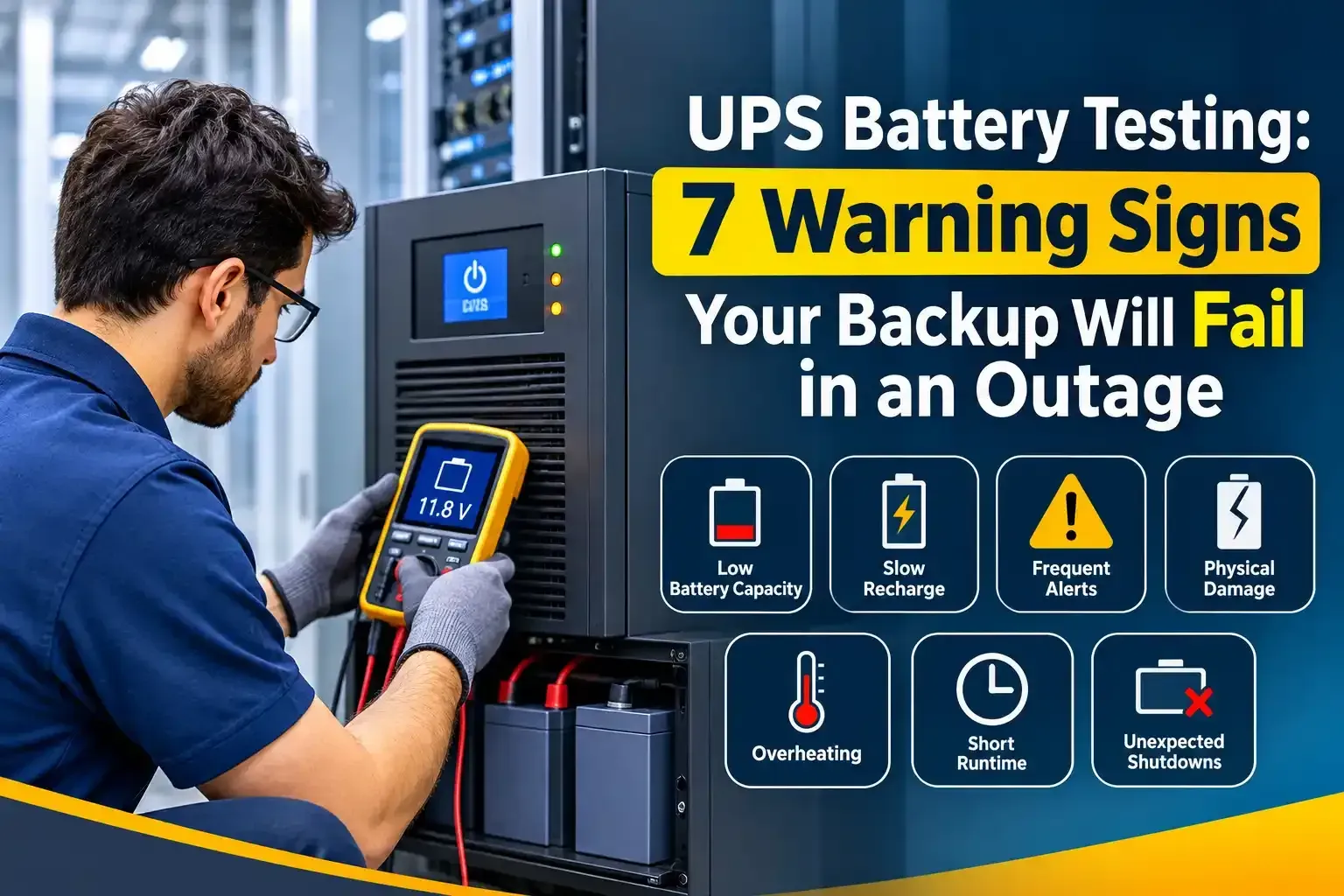
UPS battery testing is the only dependable way to know whether your backup power will carry the load when the grid drops. A UPS can show green lights and still collapse within seconds of a real outage. For facility managers, maintenance engineers and data-centre heads across Saudi Arabia, that gap between “looks fine” and “will actually work” is where costly downtime hides.
Heat makes it worse. Eastern Province sites run hot, and extra degrees shorten battery life. That is why routine UPS battery testing matters more in Dammam, Khobar and Jubail than in cooler climates. At General Tech Saudi, a Dammam-based team working since 1998, we see the same pattern: batteries fail early, quietly and at the worst possible moment.
Below are the seven warning signs, a practical test process and guidance on when to replace.
Why UPS Battery Testing Matters Before an Outage
Most UPS-related outages are battery failures. The rectifier, inverter and static switch rarely cause the shutdown. The battery string does. Sealed lead-acid cells degrade chemically, and the loss stays invisible until they must deliver current.
A battery that holds float voltage can still have lost half its capacity. Float voltage only proves the cells are charging, not how much energy they can release. Proper UPS battery testing measures what the string can actually deliver under load.
The stakes are high everywhere. A control-room UPS dropping out means lost visibility on process units, theatres and patient monitoring need seamless transfer, and seconds of interruption can corrupt data in a server room.
7 Signs of UPS Battery Failure to Watch For
Spotting the signs of UPS battery failure early lets you test, service or replace on your schedule instead of the grid’s.
1. Runtime Is Shorter Than It Used To Be
If a UPS that once carried the load for fifteen minutes now manages five, capacity has dropped. Shorter runtime is the clearest early signal and the first reason to schedule UPS battery testing.
2. The Battery Is Past Its Design Life
Age is the most reliable predictor. Standard VRLA batteries typically last about three to five years in real conditions, and so-called ten-year units often deliver closer to five to eight years in warm rooms. Compare each block’s date code against the UPS battery life expectancy you can realistically expect on site.
3. Swelling, Leaks or Case Distortion
A bulging or cracked case means internal pressure or overheating. Treat any physical distortion as a stop-and-replace finding.
4. Heat or Corrosion at Terminals
Warm terminals, crusting and loose connections add resistance and cut the current available during transfer. Thermal imaging is one of the fastest ways to catch it.
5. Unexplained Alarms and Failed Self-Tests
Repeated “battery replace” alerts, failed self-tests or random transfers to bypass mean the UPS has failed its own battery health check. Clearing the alarm without testing the string is an expensive mistake.
6. Voltage Collapses Under Load
A weak string sags when the load transfers, and the UPS shuts down early. This is why a UPS battery load test reveals problems a simple voltage reading never will.
7. Rising Internal Resistance Between Blocks
When one block in a string shows noticeably higher impedance than its neighbours, it is ageing faster. One weak block can drag down the whole string, so trending resistance readings from every visit is essential to effective UPS battery testing.
How to Test a UPS Battery: A Practical Process
To learn how to test a UPS battery properly, follow a layered approach, because each step catches different faults.
- Inspect visually. Look for swelling, leaks, corrosion, dust and cabinet temperature.
- Record float voltage. Log string voltage and individual block voltage against the manufacturer’s range.
- Measure impedance or conductance. Compare each block with its neighbours and its own baseline.
- Run a UPS battery load test. Apply a controlled load and watch how voltage behaves.
- Perform a UPS battery capacity test when readings are borderline or the string is near end of life.
- Document everything. Keep dated results so trends are visible from one visit to the next.
UPS Battery Load Test vs Capacity Test
A UPS battery load test checks whether the string holds up under a short, realistic demand. A UPS battery capacity test discharges the string toward its end voltage and measures the energy delivered against the rated figure. Industry practice, including IEEE 1188 guidance for VRLA batteries, treats about 80 percent of rated capacity as the point where replacement should be planned.
Load tests suit routine checks, while capacity tests give the definitive answer. Serious UPS battery testing programmes use both.
A Simple UPS Battery Health Check Between Visits
Your own team can run a basic UPS battery health check monthly: review alarms and the last self-test, note cabinet temperature, compare runtime with last month and photograph terminals so changes are easy to spot.
UPS Battery Testing Frequency and Preventive Maintenance
How often should you test? It depends on criticality, battery age and room temperature. A sensible timeline looks like this:
- Monthly: visual checks, alarm review and the built-in self-test.
- Quarterly: voltage, temperature and terminal inspection.
- Every six to twelve months: impedance readings and a load test by a qualified technician.
- Annually, or as the string ages: a full capacity test.
Fold these into a structured UPS preventive maintenance plan. Our UPS preventive maintenance and related repair and support services are delivered from our Dammam base, so your team is not chasing separate vendors for batteries, panels and drives.
Test results are only as good as the instruments behind them. Meters and load banks drift, so accredited calibration of your electrical test equipment belongs in the same programme.
UPS Battery Replacement: When to Act
UPS battery replacement should be planned, not reactive. Plan it when any of these appear:
- Measured capacity falls to roughly 80 percent of rated.
- Two or more blocks show high impedance or voltage deviation.
- The string reaches the end of its realistic service life.
- A physical defect such as swelling or leakage is found.
Replace the entire string together, because mixing new and old blocks shortens the life of the new ones. Schedule the work in a planned window and dispose of old batteries through a licensed route.
UPS Battery Maintenance Saudi Arabia: Climate and Site Factors
Good UPS battery maintenance Saudi Arabia projects start with the environment. High ambient temperature, dust and humidity near the coast all accelerate wear. As a rule of thumb, sustained operation above 25 degrees Celsius shortens VRLA life noticeably.
Practical measures for Eastern Province sites:
- Keep battery rooms cooled and monitor temperature continuously.
- Seal cabinets against dust and keep filters clean.
- Keep a dated log of every test for audits and warranty claims.
These habits stretch battery life and make trends easier to read.
UPS Battery Testing Service Dammam: Choosing a Partner
If you want a UPS battery testing service Dammam teams can book, look for a provider who documents readings, explains findings plainly and recommends replacement only when the data supports it.
General Tech Saudi supports industrial, oil and gas, healthcare and commercial clients across the Eastern Province, Riyadh, Jeddah and Yanbu. Our engineers already handle UPS preventive maintenance, thermal imaging and electrical equipment support, so confirming the right UPS battery testing scope for your site is a single conversation. For more engineering guidance, browse the latest updates and technical articles on our site.
Frequently Asked Questions About UPS Battery Testing
How often should UPS battery testing be done?
Check visually each month, measure voltage and temperature quarterly, and run impedance plus a load test every six to twelve months. Add an annual capacity test for critical or ageing strings.
How long do UPS batteries last?
Most sealed lead-acid UPS batteries last three to five years, and ten-year designs often reach five to eight in hot rooms. Heat matters as much as age.
Can I test a UPS battery myself?
You can do visual inspections, alarm reviews and basic readings. Load, impedance and capacity testing need calibrated equipment and trained technicians, mainly because discharging a string carries electrical and chemical risks.
Test Before the Outage Tests You
Regular UPS battery testing turns warning signs into planned work, protects your critical load and removes surprises. If your batteries are ageing, your runtime is falling or you simply cannot remember the last proper test, book one now.
General Tech Saudi (BK General Tech Services Est.)
P.O. Box 9559, Al Rabie District, Dammam 31423, Saudi Arabia
Phone: +966 569 289 544 | Email: sales@generaltechsaudi.com