

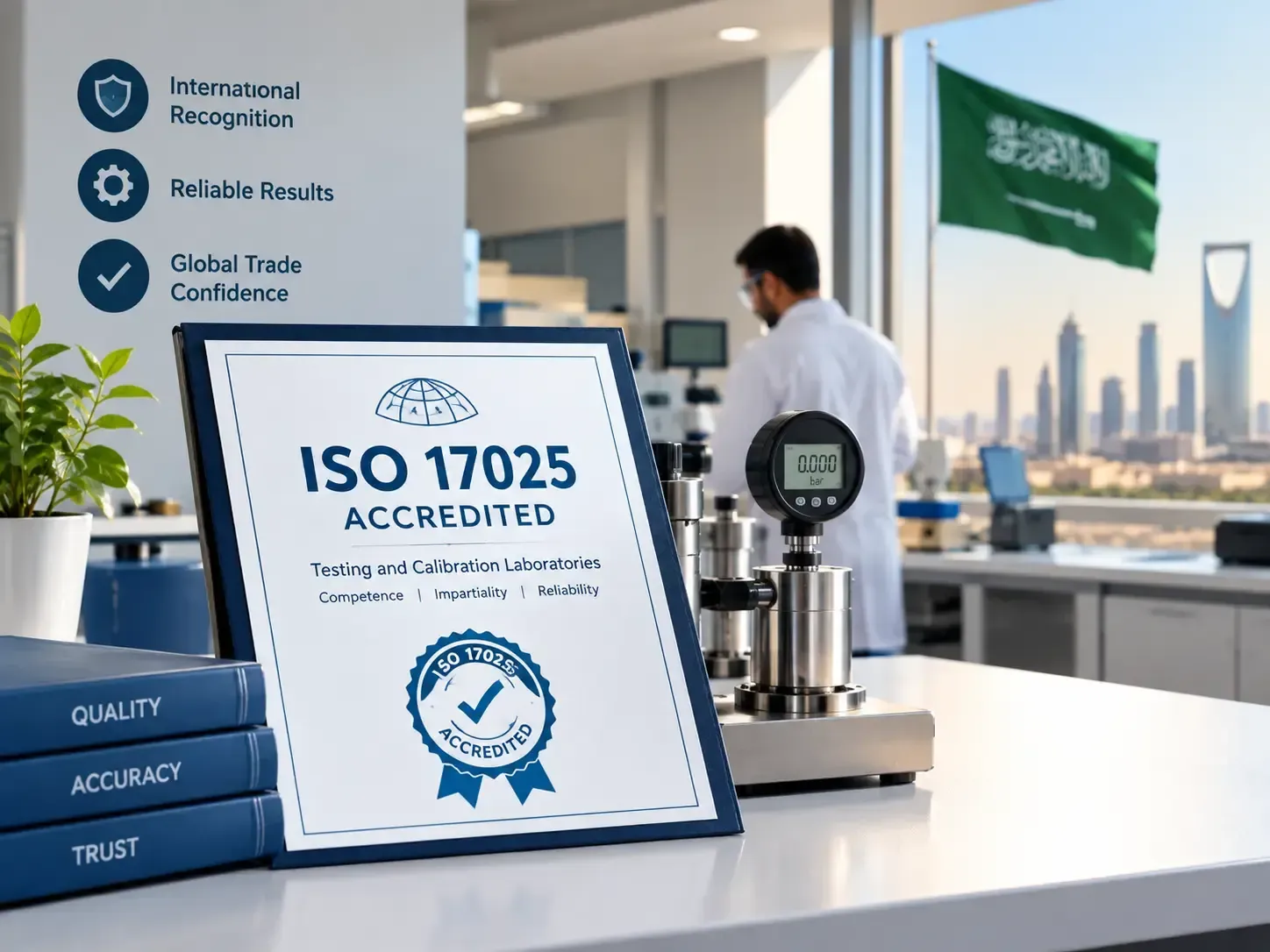
What is ISO 17025 accreditation, and why do auditors in Saudi Arabia ask for it so often? In short, it is independent proof that a laboratory is technically competent and produces valid, traceable results. For quality managers and procurement teams, that proof separates a certificate that survives an audit from one that does not.
Many buyers still select calibration suppliers on price and turnaround alone. That choice can backfire when an auditor questions the certificate. This guide explains the standard, the Saudi accreditation system and the practical steps for checking a supplier before you buy.
What Is ISO 17025 Accreditation? The Plain-English Answer
ISO/IEC 17025 is the international standard for the competence of testing and calibration laboratories. Accreditation means an independent body has assessed a lab against that standard and confirmed it meets it.
Three points are worth remembering:
- Accreditation is not self-declared. An external accreditation body audits the lab.
- It is specific. It covers named measurements and ranges, not the whole lab.
- It is ongoing. Labs are reassessed on a regular cycle.
Put simply, accreditation answers one question: can you trust this lab’s numbers?
ISO/IEC 17025:2017 Requirements: What the Lab Must Prove
The ISO/IEC 17025:2017 requirements are grouped into five areas. Together they cover both people and processes.
- General: impartiality and confidentiality.
- Structural: legal identity, management and defined responsibilities.
- Resource: competent staff, calibrated equipment, suitable facilities and traceable reference standards.
- Process: validated methods, measurement uncertainty, record keeping and result reporting.
- Management system: document control, internal audits, corrective action and management review.
The process area matters most to buyers. It requires the lab to evaluate measurement uncertainty, ensure results are valid and issue complete reports.
ISO 17025 vs ISO 9001: Competence Versus Management
Buyers often treat these standards as interchangeable. They are not. ISO 17025 vs ISO 9001 comes down to what each one proves.
- ISO 9001 certifies a quality management system. It shows a company manages its processes consistently.
- ISO 17025 accredits technical competence. It shows a lab can produce valid measurement results.
A company can hold ISO 9001 certification and still deliver unreliable calibration. Only ISO 17025 examines the methods, reference standards and uncertainty calculations behind the numbers. For calibration, ISO 9001 alone is not enough.
SAAC Accreditation Saudi Arabia: The National Authority
SAAC accreditation Saudi Arabia is issued by the Saudi Accreditation Center, the Kingdom’s national accreditation body. SAAC assesses laboratories against ISO/IEC 17025 and publishes the scopes of the labs it accredits.
For buyers, this means local accreditation you can verify at the source. It also supports Saudi compliance expectations in regulated sectors such as pharma, food and healthcare.
An ISO 17025 accredited calibration laboratory in Saudi Arabia also saves time. Your auditor sees a recognized national body behind the certificate, which reduces follow-up questions.
ILAC MRA Mutual Recognition: Why Certificates Travel
ILAC MRA mutual recognition is an international arrangement among accreditation bodies. Members agree to accept each other’s accredited results. As a result, a certificate from an accredited lab can be recognized across borders.
This matters for multinational operators, exporters and contractors working with international clients. Recognition reduces repeat testing and disputes over data.
Check the current signatory status of any accreditation body on the ILAC website. Do not rely on a supplier’s claim alone.
Accredited vs Non-Accredited Calibration: What Actually Changes
Accredited vs non-accredited calibration looks similar on the surface. Both produce a certificate with readings. The differences sit underneath.
FactorAccredited labNon-accredited lab
Competence
Independently assessed
Self-declared
Uncertainty
Calculated and reported
Often missing or unsupported
Traceability
Documented chain
Frequently unclear
Audit acceptance
Widely accepted
Often challenged
Oversight
Regular surveillance
None
This is the practical answer to what is ISO 17025 accreditation worth in money terms. A cheaper non-accredited certificate can force a repeat calibration, a failed audit or a product review. The saving rarely survives that cost.
What an Accredited Calibration Certificate Should Show
An accredited calibration certificate carries more than readings. Look for these items:
- The accreditation body’s mark and the lab’s accreditation number
- Unique certificate number and instrument identification
- As-found and as-left readings
- Expanded measurement uncertainty and coverage factor
- Reference standards and traceability statement
- Method, conditions, date and authorized signature
If the lab calibrated outside its accredited range, the certificate should not carry the accreditation mark. Check this every time.
Laboratory Accreditation Scope: The Detail Buyers Miss
Laboratory accreditation scope is the list of measurements a lab is accredited to perform. It defines the quantity, range and best measurement uncertainty for each service.
A lab can be accredited and still lack scope for your instrument. For example, a lab accredited for pressure up to 100 bar cannot issue an accredited certificate at 700 bar. Match three things against your instrument:
- The discipline (pressure, temperature, torque and so on)
- The measurement range
- The uncertainty the lab can achieve
Your equipment must fall inside all three before the accreditation means anything for your purchase.
Traceable Calibration Saudi Arabia: Linking Results to Standards
Traceable calibration Saudi Arabia means every result links back to national or international standards through an unbroken chain of comparisons. Each link has a stated uncertainty.
An accredited lab must demonstrate this chain. Its reference standards are calibrated by bodies that are themselves competent and recognized. The certificate should name the standards used and their own calibration references.
General Tech Saudi’s certificates trace to NIST and other recognized national standards. That gives Saudi buyers a documented chain they can show an auditor.
How to Verify Lab Accreditation in Five Steps
Knowing how to verify lab accreditation takes minutes and protects your audit record.
- Ask for the accreditation certificate and scope document.
- Check the accreditation body. Confirm it is a recognized body such as SAAC.
- Confirm the validity dates. Accreditation lapses if not renewed.
- Match the scope to your instrument. Compare discipline, range and uncertainty.
- Verify with the body directly. Use the accreditation body’s published directory.
Repeat this check at each supplier review. A lab’s scope can change.
What a Strong ISO 17025 Accredited Calibration Laboratory Looks Like
Look beyond the logo. A strong supplier shows:
- Clear scope covering your instruments
- Complete certificates with as-found and as-left data
- Technical support to explain results
- On-site capability to reduce downtime
- Scheduling support for recalibration
General Tech Saudi is a SAAC ISO/IEC 17025:2017 accredited lab based in Dammam since 1998. It offers accredited calibration across eleven disciplines, in the lab or on-site across the Eastern Province, Riyadh, Jeddah and Yanbu. To keep due dates under control, its annual maintenance contracts track your recalibration schedule for you.
Frequently Asked Questions
What is ISO 17025 accreditation in simple terms?
It is formal recognition that a laboratory is technically competent to perform specific tests or calibrations and produce valid results. An independent accreditation body grants it after a full assessment.
Is ISO 17025 mandatory in Saudi Arabia?
It depends on your sector, contract and regulator. Many industrial, pharma and healthcare buyers require accredited certificates for audit purposes. Check your own requirements and customer specifications.
Does ISO 17025 accreditation cover every calibration a lab performs?
No. Accreditation covers only the scope listed. Always compare the lab’s scope with your instrument’s range before ordering.
How often is a lab reassessed?
Accreditation bodies conduct surveillance visits and periodic reassessments, so labs must keep meeting the standard to keep their status.
Final Thoughts
Understanding what is ISO 17025 accreditation helps you buy with confidence. Check the body, the scope, the traceability and the certificate content. Those four checks turn accreditation from a logo into real audit protection for your business.